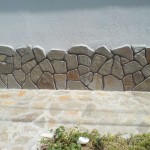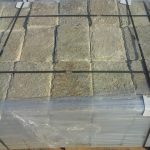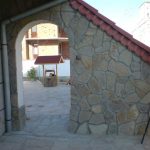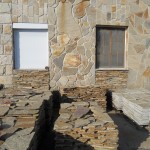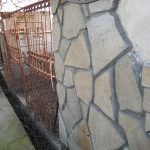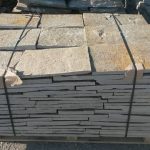
Gneiss can be used for stone walls, façade features, plinths, garden paths and steps. Choosing it starts with the project: will the stone be fixed to a wall, regularly exposed to water or carry pedestrians and vehicles? Colour is only one part of the decision.
This overview brings together the main formats and questions to resolve before installation. Links lead to more detailed articles on individual activities.
Irregular slabs, sawn stone and offcuts
Irregular slabs have natural outlines and require fitting. They suit freer layouts, but advance planning matters for even joints and sensible material use. See the examples of irregular slabs for garden paving.
Sawn stone has formed edges that make rows easier to arrange. It still needs sorting by thickness, colour and size. On façades, the fixing must suit the complete system, including insulation.
Offcuts and narrow strips are used for decorative faces and accents. Their varied shapes allow different compositions. Read more about gneiss offcuts for cladding and split-face cladding with stone strips.
What to check for wall cladding
The substrate must be sound and suitable for the stone’s weight. Slab type, height, indoor or outdoor conditions and wall condition determine the installation system. Bonding, mechanical fixing or a combination should not be chosen on appearance alone.
Stone cladding does not replace thermal insulation or waterproofing. Façade details around the plinth, windows and transitions between materials need coordination in advance. Read more about installing stone cladding and combining sawn stone with insulation.
For a new home, include these decisions when planning house construction, rather than after adjoining surfaces are complete.
Balkan Construct provides complete stone cladding and paving installations, including preparation and material supply as part of the project work.
What to check for paving and steps
The base’s load capacity, falls, drainage and expected traffic are important. Slab thickness alone does not establish suitability for vehicles. There is no universal base for every garden and soil.
Select stone with properties suited to the intended use and check surface behaviour when wet. Natural texture does not guarantee grip on ice. For steps, coordinate riser height, tread depth and finish thickness.
The practical differences are explored in the articles on a stone path on a concrete base, a path on a sand bed and natural stone step cladding. These are different solutions, selected according to the particular conditions.
Grouting, cleaning and protective treatment
Adhesive and grout serve different purposes. Choose them together with the stone and substrate, and follow technical data sheets for grouting and loading times. Movement joints must not be filled as ordinary rigid joints.
For maintenance, use compatible products and test a small area first. Sealing can reduce absorption and soiling, but does not repair a weak base or cracked slabs. See the detailed guidance on grouting stone paving and cleaning gneiss.
What to prepare for an installation inquiry
Useful information includes photographs, an approximate area, the project location, intended use and details of the existing substrate. Mention whether this is new construction or refurbishment and whether there are steps, plinths, corners or other details.
Following a site assessment, preparation, installation, quantities and organisation can be established. The service is for a complete stone installation, rather than stand-alone gneiss sales.
Request a quote for your project
Tell us what you would like clad or paved and attach photographs if available. We will discuss a suitable scope of work.